Tuesday, September 24, 2013

"Blue Jasmine" review


Brown Turd

Regardless of what you think of Woody Allen’s personal life, his talent as a writer, director and actor is prodigious and the sustained quality of his work is truly admirable.  Few filmmakers have managed to produce a consistent artistic output for over four decades.  While I had not personally enjoyed a Woody Allen movie since “Sweet and Lowdown”, I hoped that Allen’s propensity for witty dialogue and quirky characters would make “Blue Jasmine” enjoyable, but the film simply stinks.


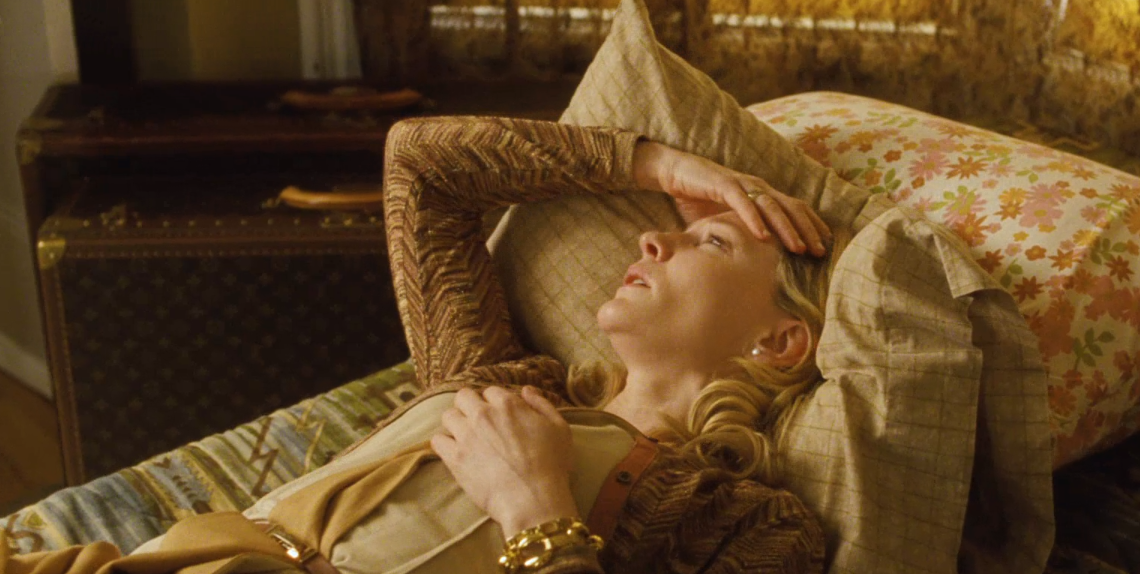
Cate Blanchett plays Jasmine, a woman who married into great wealth and is now penniless due to her husband’s arrest and conviction over countless illegal business deals.  On a plane in the opening scene, Jasmine is having a markedly one-sided "conversation" with an older woman sitting next to her.  Something is off.  When we next see Jasmine waiting to pick up her luggage, she continues her verbal ramblings.  Jasmine's senior seatmate is there, but soon beats a hasty retreat because she can smell the crazy.  Jasmine is not well, and as the story unfolds we are forced to watch her mental condition deteriorate further.


Cate Blanchett’s interpretation of a spoiled woman suddenly kicked to the curb is superlative.  Her physical beauty is sharply contrasted by the interior ugliness of someone whose narcissism made it easy for her to wrap herself in blinding layers of ignorance.  Jasmine’s breakdown is beautifully portrayed, but it is like watching a corpse decompose.  While fascinating, it is also repulsive, and the reek of Jasmine's willful self-deception is overpowering.  Yet I didn’t feel sorry for Jasmine, but I did feel sorry for Cate.  Such an excellent performance is wasted in a film without any empathy for its players.  Woody Allen usually displays warmth and affinity with at least some of his characters, but in this film his sneering condescension leaves a lingering odor.

“Wild Man Blues” and the more recent eponymous documentary about Allen painted the portrait of a man whose achievements have allowed him a rarified lifestyle, much like the one that Jasmine has lost, making it easy to interpret “Blue Jasmine” as one of Allen’s current nightmares.  Yet, given his autobiographical tendencies in previous films, whether he was mocking the elite or the working class, the humor worked because it felt like Allen knew these characters and liked them despite their flaws.  I wonder if his success has isolated him to the point where he can no longer identify with either social strata and now regards both with equal contempt.  If that’s the case, then it’s no surprise that instead of resulting in a perceptive critique of human foibles, Allen’s “Blue Jasmine” comes out like a cinematic enema.

Tuesday, August 13, 2013

"The Way, Way Back" review


Getting your feet wet

Growth is almost always a painful process, so why are coming-of-age films so  attractive?  Even the good ones often leave a residue of sadness.  There are many good moments from my youth, but the bad ones loom larger because that's when the growing happened.  Adversity requires tough decisions, and the lessons learned stay with us forever.  "The Way, Way Back" is a bittersweet tale of one boy's summer vacation where he takes his first difficult steps into the adult world.  While the story is not original, the sharp dialogue, eccentric characters and breezy pace make for a fun yet familiar frolic.


Duncan doesn't like his new stepfather Trent, and the feeling is mutual.  For his mother's sake, Duncan grimly accepts the situation, though he feels doomed to spend a miserable summer with his family in Trent's house by the shore.  Once they arrive, though the beach and the days are beautiful, Duncan steadfastly broods over his fate.  Susanna, a neighbors' daughter, senses Duncan's alienation and chats him up.  They discover that they share similar family backgrounds as both are children living with divorced single parents.  Despite this flirtation, Duncan is still not ready to come out of his shell, and remains hunched over in a state of awkward withdrawal.


Duncan's emergence is instigated by his friendship with Owen, the slacker manager of a local water park who offers Duncan a job.  While Owen's arrested adolescence initially feels familiar and safe, Duncan slowly realizes that Owen is not a good role model.  Because Owen never takes anything seriously, he avoids making those tough decisions that change a person for the better.  Duncan's job at the water park gives him a sense of responsibility, and that knowledge compels him to act, especially when he discovers Trent's dirty secret.


Being an adult is complicated and it's hard to stand up for yourself, but Duncan finally finds the courage to blurt out the truth about his stepfather because no one else will.  Duncan cannot fathom why his mother would stay with a man like Trent because Duncan is still too young to understand the kinds of compromises adults make.  Even his mother isn't sure that she's doing the right thing.  The future remains uncertain for Duncan's family, but in the end his mother shows him that she is still sure about her love for her son.

Friday, July 19, 2013

"In The Loop" review


A wearying war of words

When this film debuted, the quality of the script was universally lauded as being flush with vicious yet hilarious dialogue.  Well written scripts are rare, and no amount of money or acting talent can compensate for a badly composed screenplay.  “In The Loop” is a British production, and purported to be a welcome deviation from the typically shallow crap Hollywood often excretes.  However, the unrelenting emotional and psychological warfare proves to be an enervating experience.


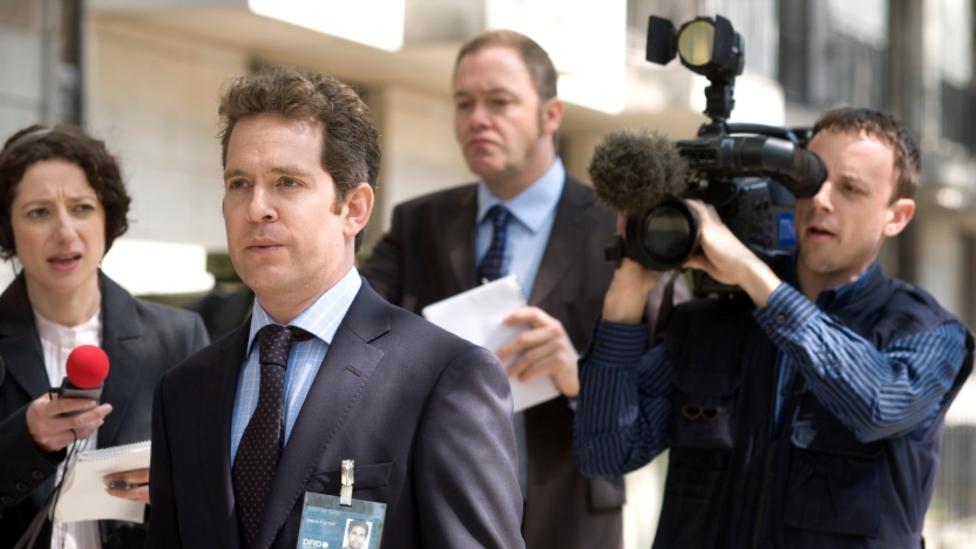
War is brewing in the Middle East, and the American and British governments are at their own sword points about how to proceed.  The focal point of their anger quickly becomes Simon Foster, the British Minister for International Affairs.  Simon is played by Tom Hollander, in a complete reversal of the role for which most Americans will recognize him: the sneering British officer Lord Cutler Beckett from the "Pirates of the Caribbean" franchise.  As Simon Foster, Hollander is a well-meaning but befuddled boob whose unapproved media remarks repeatedly land him in trouble.  Though Simon's boss cruelly criticizes him while scrambling with the damage control, Simon continues to commit the unforgivable political crime of being honest.


Aside from Simon, there are a few other characters that wish to do good, but they understand the limits of their ability to achieve real change.  Simon is the only one who doesn't get it.  While everyone around him is solely focused on advancing their own position of power, Simon remains altruistic. However, the constant threat of scandal, dismissal and death by media suicide looms over every character, and this dread atmosphere quickly becomes tiresome.  I didn't like anyone, not even Simon.  In an environment replete with such duplicity, I wanted to see one good person struggling against the miasma of narcissism, but Simon was just too dumb to support.


Perhaps the point of the film is that one person cannot make a difference, but that is a depressing perspective given how self-serving modern politics appear.  While the vast majority of people in office are likely motivated solely by their own desires, it is an ugly truth in which I would prefer not to have my nose rubbed, regardless of how ruthlessly funny the conversations may be.  It is easy to be cynical about the value of human life, yet I believe that individuals can positively influence the world.  “In The Loop” does not have this small measure of hope, and it suffers from this myopic view.

Thursday, July 11, 2013

"Box of Moonlight" review


A big treasure in a tiny package

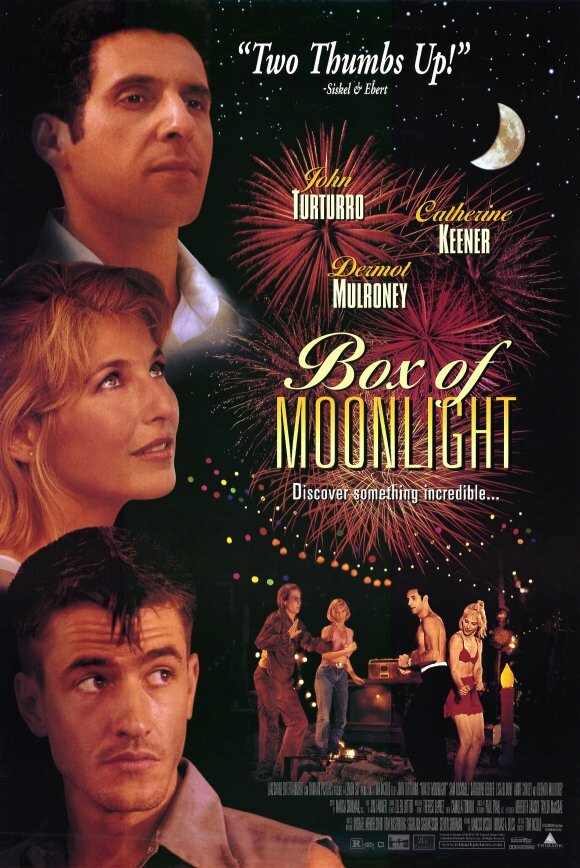
With the rise of the Independent film movement in the 1990’s many talented young filmmakers were able to share their unique vision with a larger audience, thanks in part to the increasing number of film festivals and the participation of name actors.  “Box of Moonlight”, written and directed by Tom DiCillo, is a perfect example.  This quirky dramedy stars John Turturro, who was becoming well known through his memorable roles in early Cohen brothers’ films.  “Box of Moonlight” also boasts early performances by Katherine Keener and Sam Rockwell, both of whom have gone on to develop lasting acting careers.


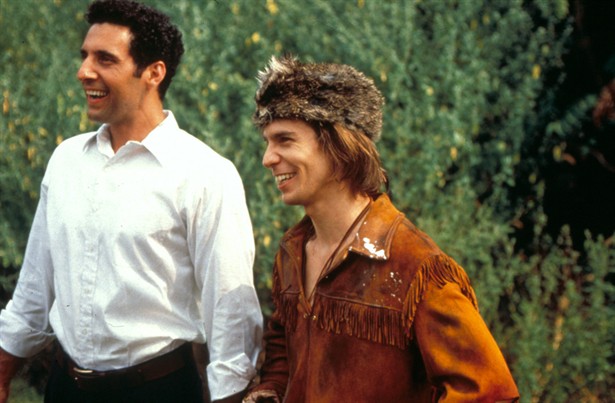
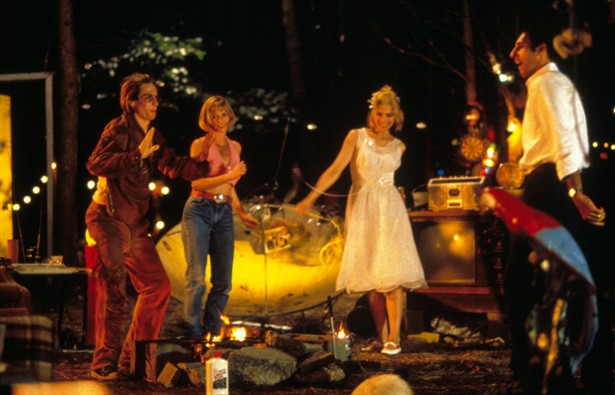
John Turturro plays Al Fountain, an electrical engineer on a field assignment that is suddenly shut down.  When Al calls home to tell to his wife and son, his calm façade belies the fact that Al is on the cusp of a mid-life crisis.  During a meal at a local diner, Al starts to see things moving backwards, and the gray strands he discovers in his hair do little to lessen his growing anxiety.  Instead of heading home, Al suddenly decides to search for a fondly remembered childhood play resort called Splatchee Lake.  When his car breaks down, Al meets a buckskin-garbed local appropriately named Bucky. Played by Sam Rockwell, Bucky is the epitome of perpetual adolescence.  He has abandoned society in order to live off the grid in a patchwork trailer, stealing electricity and making a meager living stealing and reselling lawn ornaments.


Al and Bucky strike up an unlikely friendship, and their adventures together provide the catalyst for Al to begin to finally open up emotionally.  When Al and Bucky go swimming at a partially flooded quarry, they meet two local girls.  Although Al remains faithful to his wife, his passion is reawakened by this harmless flirtation.  Al rediscovers his sense of play and the freedom it brings.  He begins to take pleasure in small things again and recognize their value.  Yet even though Al has long been feeling overburdened with so many mature responsibilities, he never forgets that he has a family.


“Box of Moonlight” is a charming and bittersweet examination of the difficulty in striking a balance between the necessity of meeting adult obligations and realizing that sometimes you just want to be silly, spontaneous, and illogical.  Al realizes that he has been working too hard, and hasn’t stopped to acknowledge and enjoy the fruit of his accomplishments.  Al also recognizes that he hasn’t taken enough time to be with his family, and when he finally returns home, the restrained yet tender scene with he has with his young son provides a spark of hope for a happier future.


Tuesday, July 9, 2013

"The Ninth Gate" review


The Devil, probably.

Roman Polanksi; just the name is a conversation killer.  The facts that may or may not be true regarding the incident which occurred almost four decades ago has tainted Polanski’s reputation ever since.  Still, he is a superlative director and his films will always be praised, even if he personally is not.  When “The Ninth Gate” was released, Johnny Depp’s rise to super-stardom was just a few years away with the first entry in the “Pirates of The Caribbean” franchise.  At to this point, Depp had still been doing more low-budget, indie films and quirky comedies.  Despite his current status as one of the major actors in the world, I believe that the reason “The Ninth Gate” is rarely mentioned in articles or discussions about Depp’s career is due to the enduring infamy of Polanski’s name.


That perpetual aura of mystery and potential evil enshrouding Polanski is also felt in every film he makes.  I have always been impressed by Polanski’s ability to create a subtle but powerful feeling of fear, even during scenes that take place amid normal surroundings in broad daylight.  Every dark corner or shadowy nook seems to hide a lurking threat, and “The Ninth Gate” is no exception.  The film is an adaptation of a book called “The Club Dumas”, yet only tells one of several stories.  Polanski has demonstrated a long-standing interest in the occult, so it is no surprise to learn that the story Polanski has chosen concerns the search for a book which was purportedly written by the Devil himself.


Johnny Depp plays Dean Corso, a successful albeit very amoral book dealer in New York, who is hired to authenticate a copy of “The Nine Gates of the Kingdom of Shadows.”  This notorious tome is owned by a wealthy publisher named Boris Balkan.  Balkan is played by Frank Langella, who evokes much of the debonair flair that made his 1979 performance of Dracula so celebrated.  As Corso begins his quest to research Balkan’s copy of the infamous book, he begins to feel that something sinister is following him and watching his every move.


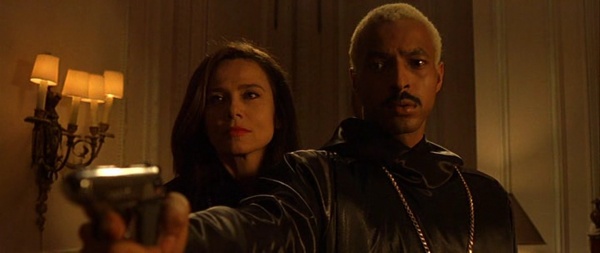
The sense of mounting dread in “The Ninth Gate” rises as inexorably as a night tide.  As Corso’s journey unfolds, two people continually appear and dog his footsteps.  One is a young black man with a close-cropped, bleached blonde afro, the other is a strikingly beautiful young woman with mismatched socks.  While these character's motivations are different, the fate of everyone is bound to the book which Corso carries with him.  In comparing his copy of "The Nine Gates" to the other remaining volumes, Corso suspects that a long-forgotten secret is about to be re-discovered, and the key may lie in the engravings in each book.  People around Corso begin to die, and his icy composure slowly gives way to panic as he senses that a great evil is waiting to be unleashed.


When Corso is assaulted in a robbery attempt, the blonde girl with the mismatched socks appears and saves his life.  She becomes Corso’s protector, and ensures that his research can continue.  Her evasive answers to Corso’s questions keep him and the audience in the dark about her true motives.  Though there is little action, what happens is almost always shocking and provocative for what it suggests about the true nature of the characters.  Is the supernatural real, or is it just a creation of our imagination?  “The Ninth Gate” gives tantalizing suggestions, but thankfully never goes completely overboard in its visual depictions.  Like “The Exorcist”, this film doesn’t paint in broad strokes.  We only see things which could actually occur, no bogeyman or spirit erupts in all its CGI glory to spoil the sophisticated suspense.


The musical score for “The Ninth Gate” is one of my all time favorites.  It is such a perfect compliment and enhancement to the visual aspect of the film.  Composed by Wojciech Kilar, the combination of classical strings with jaunty harpsichord ditties is whimsical and darkly titillating.  There is also the haunting performance of South Korean soprano Sumi Jo, whose soaring vocalizations lend a gorgeously funereal flavor to the foreboding mood.  When her wordless solos are combined with Kilar’s score, the mixture is one of transcendent doom.  Just as Corso cannot stop his search for the truth despite the increasing danger, we cannot stop listening to the music and watching the film.  Although it promises to lead us somewhere terrifying, we have already been seduced by the spell of the unknown that may lie in wait just beyond our limited vision.


If you are the kind of viewer who prefers a clear-cut ending in order to be satisfied, you may not enjoy this film.  A great part of the appeal of “The Ninth Gate” is that it only shows enough to suggest what may be happening.  We do see things that could be supernatural, but it could also be that we are seeing these things through the eyes of the main character.  “The Ninth Gate” challenges us to doubt everything we see and think about the world around us.  Is there, in fact, a spiritual veil over our eyes that we can remove if we so desire?  Is knowledge worth gaining for its own sake despite the risk of fiery damnation, or is ignorance a better choice if it makes feel us safe and surrounded by the warm light of day?  “The Ninth Gate” does not answer these questions, but it does suggest that there are many doors to perception that may be opened, but depending on your choices you may not be prepared for the fate that awaits you.


Wednesday, June 26, 2013

"Man of Steel" review


Too much steel, not enough man.

When the original “Superman” film came out in theaters I was eight years old.  Aside from “Star Wars”, it is one of the most treasured movie-going experiences of my youth.  When my parents and I left the theater, I was so overcome with what I had experienced that I looked up into the night sky.  Over one of the government buildings an American flag was fluttering in the spotlight.  My fleeting glimpse combined with the potency of my childhood imagination transformed that flag for a second into a red cape, and for the briefest of moments, I thought Superman was real.  I believed.  Since that day, I have been patiently waiting for another cinematic hero to sweep me off my feet and fill me with the same hope, excitement and joy that I experienced as a child.


Adulthood brings a lot of changes, and one of the biggest is the loss of innocence.  Despite all the ugliness and cruelty in the world, I still want to believe in something pure, someone like Superman who evokes the warm glow of old-fashioned, aw-shucks Americana. Unfortunately, "Man of Steel" has almost none of this.  The film is cold and grim, and nearly bereft of nostalgia.  My worry over the choice of Zack Snyder as the director was confirmed.  I've seen most of Snyder's previous films, and haven’t enjoyed any of them except for his 2004 remake of “Dawn of the Dead.”  His visual style fit that film perfectly as the shaky cam and frenetic pacing were appropriate for a zombiepocalypse.  Yet this chaotic and grim aesthetic is present through all of his succeeding works and it doesn't fit a Superman movie at all. There are also other major problems.


Superman is a difficult character to update because he is a creation so emblematic of his time.  Though Superman is a child of the thirties, he grew to maturity in the forties and fifties, when American culture was at its apex of confidence and dominance.  The nostalgic aura is what gives Superman his primary emotional and psychological attraction, and this key component is evoked beautifully in a very insightful scene from Joss Whedon's “The Avengers.”  S.H.I.E.L.D. agent Phil Coulson and Steve Rogers (Captain America) are having a conversation about Captain America’s costume.  Cap thinks that his WW II-era outfit might be a little old-fashioned.  Coulson counters by saying:  “With everything’s that’s happening right now and everything that’s going to happen, I think people could use a little old-fashioned.”  I thought of this sentiment often while watching “Man of Steel" because it does very little to evoke the Superman of old.


The scenes of Superman’s boyhood in Kansas are the only ones that provide any emotional connection.  The shaky cam is finally set on a tripod and the characters are given a chance to interact.  However, the fractured nature of the editing between the past and the present breaks up the necessity of showing us how and why Superman grows up to be the personification of truth and justice.  Superman is a simple character, and his story should be told in a simple fashion.  These flashbacks provide brief pauses of warmth, but they are too few to carry us through the headache-inducing barrage of CGI mayhem that comprises the entire third act.


Superman and his enemies beat the crap out of each other for extended periods, but it's nearly impossible to understand what's going on because the editing is so accelerated that the action becomes incomprehensible.  The collateral damage done by the combatants topples multiple skyscrapers, and I was shocked to see so many human casualties ignored.  One of the more clever scenarios in "Superman II" was when the villians discover that Superman actually cares for humans and use this knowledge against him.  In "Man of Steel", Superman is oblivious to the wanton destruction occurring around him, and I couldn't believe that he would allow, much less contribute to such massive loss of life.

   
The original “Superman” film did not try to beat the audience into submission.  It quietly seduced us because it had charm to spare.  It wasn’t just the acting talents of Christopher Reeve and the good-natured yet cheesy atmosphere.  It was that the filmmakers understood the character of Superman.  They knew that he was a farm boy from Kansas who wanted to express his gratitude for having a new world to call home by doing all he could to make it a better place.  Superman had no angst, he never doubted himself, and always knew that what he was doing was right.  Superman never worried whether people would like him; he saved them and let the love come naturally.  Even though he was the Man of Steel, inside him beat the altruistic heart of all of us.

Sunday, June 9, 2013

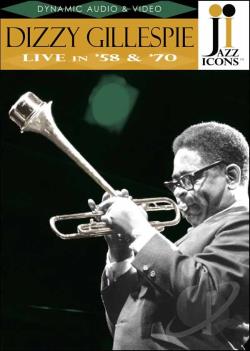
"Jazz Icons - Dizzy Gillespie - Live in '58 and '70" review


After being mesmerized by the incomparable Ella Fitzgerald DVD in this same series, we returned to our local library to see if more musical treasures were waiting for us.  In a funny role-reversal, even though the database said that the discs were available, I was having difficulty locating them.  Then a former client from my video store turned the tables and helped me find the right section!  The other three DVD’s in the Jazz Icons series were grouped together and we rented them all.  We started with Dizzy Gillespie, and even though jazz is a genre of music I’ve yet to dive into, I was slowly and surely captivated by the immense creativity that I saw and heard.

Like the Ella Fitzgerald DVD, this disc also has two concerts which are separated by enough time to see the evolution of the performer.  The first performance by Dizzy was recorded in Belgium in 1958.  All the band members sport sharp tuxedos as one would expect from this era.  While I was not familiar with any of the songs, the depth of talent on the part of every performer was phenomenal.  What I found most interesting was that even though Dizzy Gillespie is clearly the front man, sax player Sonny Stitt seems to get more solo time throughout the show.  It was a magnanimous move on Dizzy’s part to let his other band members have so much time in the spotlight, and it showed how confident and humble Dizzy was.  The songs built on each other, each one more complex and chaotic than the last, while never losing the textural thread of the particular piece.  Sonny Stitt’s solos were amazing!

The second concert in Denmark in 1970 marks a radical change.  Of course, over ten years have passed and much social and political upheaval has occurred.  Dizzy has grown an afro to compliment his soul patch.  The tuxedos have vanished, and each band member is now dressed in their own particular style.  The effect of the Love Generation on clothes is evident.  While the music is still very much the same in some ways, the effect of the times upon Dizzy is so clear in the emotional tone of his performance.  The second song, “The Brother K”, written for Martin Luther King Jr., was when my first “moment” happened.  I suddenly felt the song filling me up as I was awestruck at the intense outpouring of so many deep and intense emotional chords.

King had been assassinated just two years before, and the fires of change born in the sixties youth culture were being slowly extinguished.  The next generation inherited a pile of ashes, and the seventies became a decade thoroughly suffused with a bitter atmosphere of cynicism and regret.  In “The Brother K”, Dizzy composes a beautiful yet heartbreaking distillation of so much promise unfulfilled and so much loss not yet acknowledged that it made my heart ache.  Even though I had not lived in those times, he poured forth such a heady draught of pure emotion that blew me away with the gentle ferocity of his expression.  I could feel the pain and the suffering of all those who struggled in those tumultuous times.  It was time travel accomplished with music.

The songs that followed built on this principle, and each one brought me to another place.  Some felt familiar, some were lively and Latin, some were new and I was again amazed at Dizzy’s ability to present so much emotional content with such an economy of performance.  The marked difference between the two concerts is found not only in the dress and the relationship of the band to the audience, but in the goal of the performances.  In the first concert the band is there purely to entertain.  Much time had passed when the second concert was recorded, and Dizzy had grown so much that he had a new, more important goal: to communicate.

Dizzy wanted the audience to feel what he felt, to take a journey with him through the past so that the future could be a better place.  There was no stage separating the band from the crowd.  In fact, Dizzy had a charming interaction with a parent with a small child, and the intimacy created in this moment would have been impossible with a barrier like a stage between them.  Dizzy wanted to connect with his audience, and he did so in such an earnest and honorable fashion that I’ve now created a Pandora channel for him so that he can continue to speak to me.