
Thursday, July 16, 2015

"Deadwood" series review


“Deadwood” – Saddle up, c*cks*ckers!

David Milch was a name known to me from his work on “Hill Street Blues” and “NYPD Blue”, both of which are TV shows that I loved when they were new.  Though now dated to modern eyes, they still retain a nostalgic charm.  Being the older show, “Hill Street Blues” creaks quite a bit.  Much of the humor is more rooted in caricature rather than character, and the transitions from comedy to drama are sometimes abrupt.  “NYPD Blue” works much better in balancing the professional and personal lives of the players, but the purposeful shaky cam, which felt fresh at the time, is now somewhat seizure inducing.


When “Deadwood” first premiered on HBO, I wasn’t particularly interested, even knowing of David Milch’s involvement.  How relevant could a Western TV show be in the 21st Century?  Well, to my everlasting joy, “Deadwood” revealed itself to be one of the absolute best shows about the human condition that I’ve ever seen.  The only reason that I place “The Wire” above it is because that show was able to finish its run and complete its story.  While “Deadwood” was cut down before it had finished growing, the three seasons that exist are astonishing in their 
psychological complexity and heady cornucopia of human foibles.


The Writing

David Milch’s writing for “Deadwood” evokes the density of a German Chocolate cake and matches it both in darkness and deliciousness.  The double and sometimes triple inversions of sentence structure make digesting dialogue a challenging and alluring mystery.  It also makes re-watching a delight as you get closer to understanding what some the characters are actually saying.  This particular style also gives the verbal exchanges an antiquity that feel real instead of artificial, and each character has a slightly different delivery, which further distinguishes their individuality and temperament.


The Acting

The cast of “Deadwood” is legendary, and though it is comprised of grizzled veterans and pink-faced newcomers, all deliver sterling performances.  Ian McShane as bar and brothel operator Al Swearengen appears at first to be a rapacious beast with barely enough humanity remaining to walk upright.  Yet as the episodes unfold, Al reveals the faintest glimmer of compassion underneath his raging, blustery armor.  Al Swearengen is the rageaholic version of Ebeneezer Scrooge, and yet Al is lovable despite his cruel tyranny and marrow-targeted jibes.  Even the most base of human animals have the capacity for empathy, and Al constantly teases the promise of his reclamation.


Every single other member of the cast acquits themselves in superlative fashion, with one personal exception.  Though my wife would disagree, for me there is something missing from Kim Dickens’ turn as Joanie Stubbs, the fragile blonde madam of the Bella Union.  Her limited emotive range fails to do justice to the ghastly emotional pain that roils within her.  Joanie Stubbs’ personal history would be enough to unhinge anyone, but the mostly placid eyes, static mouth and unwrinkled face do not convey the weight of psychological torment that threatens to pull her down.


The Costume Design

As with special effects, I also believe that excellent costume design should not call attention to itself.  It should be seen, but not noticed.  I hope that makes sense!  Every character in “Deadwood” displays a mode of dress that reflects their history, personality and status.  Whether dressed in the latest East Coast silks & taffeta of the aspiring socialite or in the cracked, sun-blasted leathers of the weary but hopeful prospector, the level of detail and texture in every character's wardrobe tells us who they are or what they would like to be.  The wear and tear, the dirt and the dust are all applied in just the right amount, which further distinguishes each denizen of Deadwood.


Production Design & Cinematography

Beyond the variety of each character's costume, the streets and houses of “Deadwood” are another filthy yet fascinating feast for the eyes.  Every hotel room, hovel or tent is filled with mementos, totems and other objects that enhance the sense of these spaces as being lived in.  The motes that swirl inside of the dust-caked windows, the smoke that curls serpentine into the cool evening air and the omnipresent atmosphere of grime and stench can almost be tasted on the tongue.  “Deadwood” is so dirty that you can practically feel the grit crunching between your back molars.  Yet, there is a captivating beauty to be found amidst the mud and refuse, and the cinematography often achieves a dreamlike state despite the frequently nightmarish setting.


Story & Character Development

What sets “Deadwood” apart from so many other shows is how the characters grow individually and in reaction to one another.  Initially, Al Swearengen is the epitome of evil; an alcoholic, abuser and adamant opponent to all who would dare challenge him.  But as the series progresses, others are introduced who make Al seem. . . not so bad.  It’s not just because we’ve learned a little bit more about Al and from where his anger erupts, it’s that “Deadwood” keeps topping your expectations.  Just when you think you have a character figured out, something happens to turn all your predictions to naught.  Most importantly, these revelations expand our understanding instead of confounding us with contradictions.


Just when we’re sure that Al Swearengen is the worst excuse for a human being that we’ve ever had the displeasure to know, Cy Tolliver rolls his wagons, whores and card sharks into town and sets up a brand new brothel. The gussied-up Bella Union with its fancy décor and perfumed pros stand in stark contrast to the creaky planks and threadbare slatterns of Al's Gem Saloon.  However, Cy has an even bigger anger management problem, and we now have a new devil to loathe.  Then the infamous George Hearst descends upon Deadwood to further expand and consolidate his gold mining enterprise, and we are forced to reevaluate our opinions for a third time.  Is George Hearst’s heart as black as the hills of South Dakota?


Unfortunately, “Deadwood” was never able to fully answer this and many other questions, as numerous behind-the-scenes events conspired to prevent the show from starting its fourth and possibly final season.  David Milch did not plan for the story to run much longer than this because his intent was solely to explore the murky minefield of flawed but resolute people who are forced to cohabitate and collaborate in their attempt to create order out of chaos.  Milch was fascinated with the process by which these disparate souls would struggle to find their way together toward an uncertain future.  The show may have ended before its time, but the struggles and triumphs that “Deadwood” depicts regarding community and sacrifice are timeless.


Saturday, June 13, 2015

"The Babadook" review


Thrills, chills and most importantly, smarts!

When teenagers became the default target audience for horror films in the early nineties, the variety of scary movies narrowed so drastically that the entire genre was notoriously rebranded as “torture porn”… a succinct summation, as the aberrant whiplash from jiggling breasts to jittering entrails is ridiculous and repulsive.  This cinematic schizophrenia presents a particular problem for older, more discerning viewers who prefer a story that involves more than boobs and bloodshed.  Thankfully, “The Babadook” is utterly absent the hormonal illogic of adolescence: it is an intelligent and mature supernatural thriller.


Writer/director Jennifer Kent’s debut is a baroque descent into madness.  The story is meticulously crafted, in large part because the characters and setting are so realistic and compelling.  Single mother Amelia, stoically portrayed by Essie Davis, struggles to raise her quirky six-year-old son, Samuel, in a startling performance by Noah Wiseman.  Amelia works in a nursing home, and is still trying to reconcile the death of her beloved husband in a car accident on the day of Daniel’s birth.  Amelia is also grappling with Daniel’s behavioral oddities which have made him a pariah at school.  Though their life is stressful, they take solace in each other.


However, Amelia and Daniel’s strained existence soon becomes haunted by a growing anxiety.  The fear germinates from what appears to be a children’s book called “Mister Babadook.”  Though the text is benign, the starkly illustrated pop-up pages reveal a looming, amorphous figure with dagger-like fingers and a clown face of leering malevolence.  It seems likes spooky but harmless fun, but afterwards Daniel begins having horrible hallucinations.  Essie tries to destroy the book, but it reappears unharmed and even more ghastly things begin to manifest themselves.


What started as a smoldering ember of apprehension is slowly yet diabolically fanned into an inferno of white-hot paranormal panic.  Amelia and Daniel find themselves relentlessly stalked by a specter that threatens to destroy them from the inside out.  The Babadook wants to devour their sanity as well as their souls.  Creaking doors, thumping walls and shaking beds turn Amelia and Daniel’s nights into a hellish trial of sleep deprivation.  Pushed to the brink of exhaustion, Amelia’s rationality unravels and she lashes out violently, even at her bewildered child.


“The Babadook” teases the mind and triggers the gooseflesh because the film relies not on visual effects, but on the reactions of the characters to convey the emotional shocks.  The actor’s expressions are thrillingly frightful precisely because the audience is left to imagine so much of what is not shown.  This restraint is crucial, and it holds through to the end.  The epilogue is magnificent because even though it makes sense, exactly what has happened remains a mystery.  The story is not necessarily over, and the lingering ambiguity is tantalizing in the extreme.  Sometimes the most spine-chilling thing of all is not knowing.

Tuesday, May 26, 2015

"Mad Max: Fury Road" review


A Galvanic Spasm of Feminist Fury

The ladies have taken the stage on the blasted heath of the apocalypse, and it is good.  At first, the trailers for “Mad Max: Fury Road” didn’t captivate me, but when I heard of the potent female characters and themes present in this latest installment of the dystopic franchise, my interest was kindled.  Aside from Tina Turner’s intriguing but ultimately unintimidating Auntie Entity, no other woman had stood stoically amidst the burning sands of George Miller’s machismo-soaked landscape and staked a claim to destiny.  Of course, doing so comes at a considerable cost.


“Mad Max: Fury Road” is not just a film.  It is an endurance test.  It is a relentless and nearly exhausting assault on the eyes, ears and psyche.  However, the beauty behind this beast is that every jab, stab and spurt has a meaning and purpose.  The violence is brutal, but it is necessary because the violence is the story.  At this point, exposition is largely superfluous.  There are few words spoken in the wasteland, and almost all sound death.  While there is also very little plot, there is no need for it.  Survival demands action, and the action sequences are utterly astonishing.


It is impossible to overstate the quality and variety of the stunt work in this film.  The cinematography and editing is also truly amazing.  What a pleasure to have the eyeballs astounded by sights that actually happened!  In an age where spectacle is easy to calculate in the cold nether regions of a thousand hard drives, George Miller hurls the audience screaming into a real desert.  The sun bleaches the eyes, grit crunches between the teeth and the coppery taste of blood salts the tongue.  The visceral vitality of this world is beguiling despite its desolation.  What delicious irony that a movie so bleak can inspire such exultations of joy and triumph!


Max rarely speaks in this outing, and some have lamented that he doesn’t even feel like the main character anymore.  But there have been three previous films with Max firmly in the lead, so the time is ripe for new characters to have their stories told because their conflicts mirror and/or contrast against the burned-out husk that is Max.  Charlize Theron as Imperator Furiosa is a phenomenal new lead character.  While the fact that Furiosa is female is significant, what is more crucial is that her character is not solely defined by her gender.  If Furiosa were male, she would be much like Max.  This equivalence of ability, agency and personal power elevates the franchise to a new level of maturity.


“Mad Max: Fury Road” is the best kind of summer blockbuster.  The film pretends to present a simple action adventure for an evening’s entertainment, and it succeeds in every possible way.  Yet the story is pregnant with ideas, motifs and inspirations, and while not all of them are fully formed, the sumptuous production design fills the screen with details that make sense and allusions that are powerful.  However, there are also many little moments and minutiae which have been cleverly inserted amid the chaos.  Many seeds have been planted, and how they will bear fruit in future films is an extremely tantalizing mystery to ponder.

Lieutenant Ellen Ripley would be proud!


Saturday, May 9, 2015

"Avengers: Age of Ultron" Review


Strong start, but faltering finish

Admiring the facility with which writer/director Joss Whedon handles large casts of characters while deftly balancing comedy and drama, I was very excited for the first “Avengers” movie.  While that initial film was an overwhelmingly fun experience in the theater, soon afterwards I realized that I was disappointed with the antagonist.  Loki felt more mischievous than dangerous, and the Chitauri were too generic to be genuinely threatening.  When the robotic ravager Ultron was announced as the villain of the next installment, I was excited!


The opening sequence and entire first act of “Avengers: Age of Ultron” is absolutely breathtaking as the reintroduction of our heroes occurs during a raid on Hydra technology in a winter-blanketed forest.  Joss Whedon’s talent for directing and presenting super-powered action is superlative.  I gaped in awe, guffawed with joy and roared with hearty approval at the kinetic choreography.   Each Avenger is given a golden moment to shine, and when the team finally assembles onscreen the moment is exultant in the extreme.


Damn, it’s great to see you guys again!

Yet, as the story unfolds into the second act and beyond, the intense effort to pack in so much information begins to cast an ever darkening cloud of confusion over the proceedings.  Important plot details are hastily presented, and this prevents them from sticking in the mind.  There are too many story lines and character arcs overlapping, and losing track means losing the emotional investment in what’s happening.  Once that’s gone, the movie is over.


Unfortunately, Ultron is not an upgrade in the black hat department.  He does not come off as any more malevolent or dangerous than Loki.  He monologues and threatens destruction, but Ultron himself hardly does anything truly dastardly.  No innocents are killed, or if they are, their deaths are not given the attention they should.  There was no sense of actual consequence, even during the final, epic battle.  Thought the fate of the human race hung in the balance, this dire situation just didn’t feel appropriately desperate.


While “Avengers: Age of Ultron” is at times enthralling, hilarious and gripping, it suffers from the burden of having too much to say but not enough time to say it.  The film is a delightfully fun rollercoaster, but like many amusement park rides, the euphoria recedes rapidly.  Rumor is that the Blu-Ray release will add a lot of footage that will develop the characters more and expand the story.  Hopefully this is true, as there is a really good film in there; we just haven’t seen it all yet.


Saturday, February 14, 2015

"The Contender" review


A Victory For All Of Us


Political thrillers are a penny a pound.  Even fewer have any staying power, which is often due to the issue at hand being too time specific to have any resonance beyond the generation that experienced it.  While “The Contender” is a very contemporary film, its longevity and relevance is assured for decades because the conflict it chronicles is as old as the human race.  On the surface, the film circumscribes the endless cloak and dagger machinations between Democrats and Republicans, but lurking in the lower depths is the ancient schism between men and women.  The psychological abyss that separates the sexes often seems illimitable, especially when the few bridges built across this gulf are often made of fear and hatred.


Joan Allen plays Laine Hanson, the first female senator to be nominated for Vice President of the United States.  The previous VP has died of cancer, and President Jackson Evans, cunningly portrayed by Jeff Bridges, wants the successful selection of Laine to be his political swan song.  This is one of my favorite Jeff Bridges performances.  President Evans did not rise to his position by being stupid.  While he appears to be an amiable and uncomplicated man, deep waters churn behind his cool façade.  Evans is a veteran player.  He knows the game and he sees in Laine the same intellect, passion and unwavering dedication.


Despite his noble intentions, President Evans has legions of enemies, and he knows that Laine's path to ascendancy will be fraught with peril.  Even the most altruistic and resolute souls would lose faith in humanity when confronted by the myriad and malignant forces which instantly ally themselves against Evans and Laine.  At the head of the hydra is Shelly Runyon, whom Evans defeated in the last Presidential race.  Played with reptilian grace by Gary Oldman, Shelly Runyon radiates pure cold-blooded malice.  He cannot forgive Evans for besting him, and so will stop at nothing to take Laine down, even if it means turning her confirmation hearing into an abattoir.


Shelly's verbal assaults are like a lash to the impenitent, and the abuse that Laine is forced to absorb seemingly unendurable.  The televised proceedings quickly devolve into a public execution, and the microscopic scrutiny with which Laine's private life is dissected and distorted makes hyperbole seem as bland as milk.  Yet, she holds firm.  Laine does not bend.  Even in the face of horrific insults to her character and her worth as a human being, Laine holds firm.  The indomitable stoicism of Joan Allen’s performance is simply breathtaking.  She weathers the most withering accusations, and ultimately comes out as clean as a spring closet.  Like Evans, Laine understands that you can’t fight anger with anger, you have to outlast it.


The final scene between Laine and Evans is an absolutely brilliant coda, not only for this genre of film but for all cinema.  In the cool of the evening, the solitary pair embark on a celebratory stroll of the White House lawn.  As they indulge in the amusingly ironic machismo of smoking cigars, Laine finally reveals to Evans why she held herself in check through such an ordeal.  The reason is so smart, so prescient, and so fucking awesome that you love her character even more than you did before.  “The Contender” is a brilliant political thriller, made even more resounding by the courageous and uncompromising feminist heart that beats at its very center.

Tuesday, January 20, 2015

"The Secret Garden" 1993 - review


A Public Dump

Yep!  That’s what this is going to be; an open and unabashed excoriation of a film that I flatly refused to finish.  This is quite a rare occurrence for me.  Even if I think that a movie really sucks, I can usually muster the grit to endure it to the end.  I've long felt that if I’m going to offer an opinion on something, especially if it's negative, then my knowledge should be as complete as possible.  However, I was not willing to make that sacrifice in this case.  I immediately sensed that something was wrong, and my unease grew exponentially.  Finally, I had to leave the room.  I think it was only fifteen or twenty minutes into the film.

This is exactly how I looked while watching it.

I had never known that very particular sense of personal outrage that is experienced when a cherished book is turned into a mess of a movie.  I had been disappointed with other films drawn from literary sources, but I was more forgiving because I understood the Herculean challenges involved in adapting certain works, “Dune” and “The Lord of the Rings” being excellent examples.  However, “The Secret Garden” is not a sprawling epic spanning multiple generations and eons of time.  It doesn’t have a massive cast of characters scurrying to and fro across alien landscapes filled with legendary battles between good and evil.  It’s about a young girl and an old garden.


As a book, “The Secret Garden” is a subtle, beautiful and inspiring reading experience.  The main character's transformation from a vile, selfish hellion into a sweet, altruistic angel is an absolute delight. However, her journey is a moderate one.  Real people are naturally slow to change,  and the story takes its time to detail the stages of her growth, and each tiny advance is allowed to take root before the next step is taken.  This lengthy process is not impossible in the more limited time frame of the movies because the story is very simple.  The question is whether or not the filmmaker cares to cultivate a more patient pace.


Unfortunately, director Agnieszka Holland fails spectacularly.  The first sign of trouble appears in the opening credits: “based on the book.”  Uh-oh!  Why would you need to alter anything?  “The Secret Garden” is not a complicated narrative.  The book doesn’t take more than a week to read.  There’s no reason to compress or abridge anything unless you don’t like the story.  If you don’t, why make the film at all?  If you do like the story, why would you do the author and the fans the disservice of thinking that you can “improve” it?  One cannot improve upon perfection, but alas, ego often thinks otherwise.


Once the credits were over, my disappointment increased rapidly.  The story begins in India, where a young English girl named Mary is surrounded by servants who attend to her every need.  However, despite all this attention, she is utterly alone.  Her parents want nothing to do with her, and this emotional neglect has devastating consequences.  In the book, several chapters are devoted to detailing Mary’s horrid existence, and this is crucial to demonstrate how Mary has become such a miserable creature.  More crucially, it encourages the reader to fervently hope for her eventual deliverance from darkness.  Her soul, long wilted by neglect, may still have a chance to bloom.


In this film version, Mary’s origin story races by breathlessly.  Her parents and all the servants die in an earthquake (?!) instead of an outbreak of cholera.  The earthquake is a very poor substitute.  It is too contemporary of a disaster and makes Mary’s survival seem a random act of chance, especially since she hides under a bed!  The cholera outbreak makes more sense given the time period, and it highlights the severity of Mary’s isolation.  If she had been loved, her increased physical contact with her family would doubtless have resulted in her infection and death.  The reason she survives is because she was forgotten.


Director Agnieszka Holland also seems to have forgotten the fact that audiences don’t need narration unless it describes something that is not taking place onscreen, yet Mary herself narrates the entire film.  Not only is this unnecessary because we see everything she talks about, but the narration has the effect of placing us in the narrator’s head and thus, on her side.  We see the world from her point of view, which begs us to ally ourselves with her.  However, we are not meant to like Mary in the beginning because she is decidedly unlikable.  Mary is a detestable, shrieking brat.  While the young actress succeeds in making Mary unpleasant, the narration makes her comes across as more misunderstood than misanthropic.


There are many other character misfires.  I love Maggie Smith, but her portrayal of Mrs. Medlock is hideous.  This character is somewhat temperamental in the book, but in the film she displays a disdain for children bordering on the violent.  This is NOT the Mrs. Medlock whom I came to know and love!  Other characters are also hastily sketched, and absent the peculiarities that made them interesting.  Some, like Dickon, are introduced far earlier than necessary, thus cluttering the landscape with faces we don't yet need to see.  Well, that's bloody well enough of that!  Here's hoping that the BBC version at my local video store is a little more faithful.  I have faith that it will, as the Brits tend to have a bit more respect for literary sources, especially their own!

Sunday, January 18, 2015

"Casablanca"


The exhaustion of dog paddling through the shiny sewage of most modern American films often makes you wonder why you should keep going.  Then you return to a classic like “Casablanca” and everything comes rushing back.  You realize all over again why you first fell in love with the movies.  It is quite a surprise then to discover that “Casablanca” was just one of many films on the Warner Brothers docket.  It was not consciously constructed for greatness, but through a haphazard fusion of factors and chance, “Casablanca” went on to become a Hollywood hallmark, winning several Oscars including Best Picture.  Though the story is very firmly rooted in a specific point in history, the film has lasted because the emotional struggles of the characters are timeless.


Adapted from an unproduced stage play called “Everybody Comes To Rick's”, the script went through many revisions, especially during shooting.  A lot of myth and rumor has since swirled around the history of the troubled production, most being totally unfounded.  Although Humphrey Bogart was not the first choice for the lead, Ronald Reagan was never seriously considered.  It's true that Anne Sheridan was momentarily slotted for the role that Ingrid Bergman would become best know for, but it is hard to imagine an American successfully playing such a European character.


“Casablanca” gave Humphrey Bogart the attractive opportunity to add some softness and dimension to his tough guy persona.  On the surface Rick appears to be a man’s man, but his steely exterior shields a badly broken heart.  Convinced that Ingrid Bergman’s Ilsa loved him and left him, Rick drowns his sorrows in liquor and loose women.  Bitter and resigned as he seems, when Ilsa suddenly reappears, Rick cannot deny the part of himself that still loves her more deeply than he may have realized.  When the cracks in his armor begin to show, we are glad because it means that Rick still has a chance to come to peace with his long nursed pain.


Ingrid Bergman’s performance is luminous.  As Ilsa, Ingrid radiates both innocence and mature sexuality with equal power and allure, and the combination is beautifully devastating.  She appears at first to be the good girl next door, but later scenes suggest that underneath that prim façade lurks a boudoir tigress.  It is easy to see why Rick has been so wound up over Ilsa for all these years, and even though Ilsa tries to use her wiles against Rick to get the letters of transit, there is nothing malicious about her intentions.  Perhaps it is because we know Rick is too smart to really fall for it, and he loves Ilsa too much to blame her for trying.
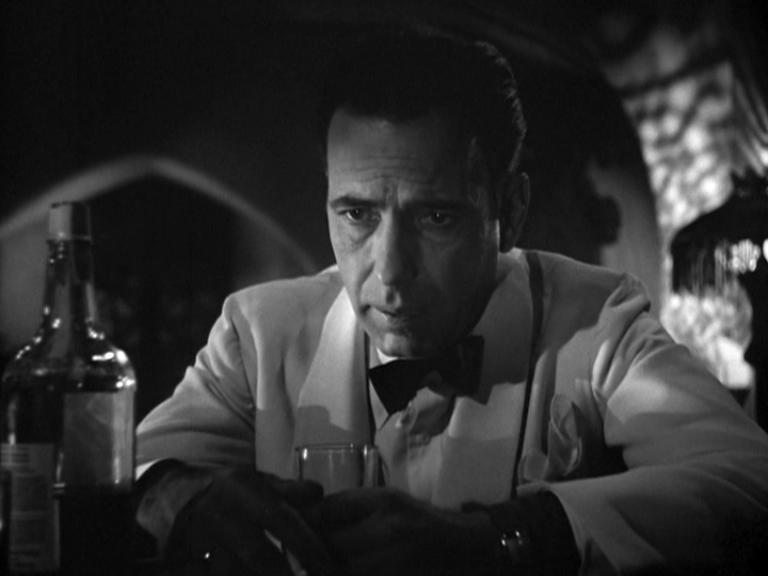

The specifics of the plot do not matter much, as it is the words and actions of the entire cast that make “Casablanca” so memorable.  Even the smallest roles shine due to the veteran character actors who make even the briefest of appearances moments to be savored.  “Casablanca” is a terrific example of a final product far greater than the sum of its individual parts.  Repeated viewings only enhance the pleasure of the experience as we anticipate our favorite scenes.  Revisiting “Casablanca” is like spending time with family, and it is a beautiful friendship that only gets better as time goes by.