Saturday, April 16, 2016

I believe a man can fly. . .again


What is the Soul of a Superman?

First of all, I am not an expert on Superman.  I’ve read very few of the thousands of comic books, and have seen only a smattering of episodes of the numerous TV shows in which he has appeared.  I’ve not even screened the third and fourth theatrical films (by choice, mind you) so my familiarity with all the iterations of Superman which have come and gone over the decades is minimal.  Still, I believe that I understand the character well enough to proceed with a passionate plea for his cinematic reclamation.


As a child my first exposure to Superman was reruns of the black and white television serial “Adventures of Superman” starring George Reeves.  Even though I didn't watch the entire series, I enjoyed what I saw immensely.  Yet my interest did not lead me towards other familiar sources such as comic books.  With certain pop culture franchises I have remained a purely visual consumer.  I am the same way with Star Wars.  While I am aware of the vast range of stories set in the Star Wars universe that are available in novels and other print media, I’ve only ever been interested in the movies and the all-encompassing sensory experience that they alone provide.


When “Superman” first came to theaters in the summer of 1978, I was a boy whose imagination was easily carried away, and not just by the colossal charm of Christopher Reeve.  The rose-colored vision of this character was equally reflected in the “modern” city of Metropolis.  I knew that this was not a realistic depiction of urban life, for I had watched the nightly news and knew what happened in big cities.  I didn’t question the omission of certain savageries because I understood that they didn’t fit into the universe which Superman inhabits, for he is not the only idealized element in this cinematic world.


The real world has changed very little in the four decades since, but attitudes towards heroes have become more complex and hyper-critical.  Even at the apex of his popularity in the fifties, Superman was viewed by many as a deluded Boy Scout, unable or unwilling to acknowledge the seemingly inexpiable failings of so much of humankind.  Today the response to Superman’s unfaltering altruism has metastasized from a bemused intellectual superiority to downright dismissive scorn.  How could he be so stupid?  Why does he even care?  What good can he possibly do?


This breaks my heart.  The knee-jerk judgments heaped upon Superman are such an ugly expression of the cynicism which has so virulently infected much popular culture and online social media.  I understand this up to a point.  There’s a lot to be upset about.  Greed, hatred and tyranny still hold much of our world in a poisonous, debilitating grasp.  Pessimism is so rampant and so accepted that even wishing for things to get better is often seen as a futile exercise.  Furthermore, even when something good does happen, often the first reactions are smug and nihilistic assumptions that it was either a fake stunt or merely a momentary anomaly from the norm of misery.


Shouldn’t that make Superman and what he stands for even more relevant and appealing?  In a world where the righteous moral path is shrouded in ever deepening shades of gray, wouldn’t you want a hero who is the most incorruptible?  Wouldn’t you want someone whom you could implicitly trust to tell you the truth and always be there to help?  What’s so wrong with actually giving a shit about the world and the people in it?  Has hope now become something to be viewed as a mental illness?  When did trying to be a good guy suddenly become a bad thing? 

I present below a superlative example of how Superman can beatifically merge with our harsher realities when he is in the hands of a writer who understands his character.


Yeah, I needed a tissue too.

Unfortunately, the three most recent films featuring Superman only serve as cautionary tales about the failure to successfully integrate his character into our contemporary global culture.  After the titanic two-part saga that unfurls through “Superman” and “Superman II”, the franchise faltered with the silly “Superman III” and then augured in with the atrocious “Superman IV: The Quest for Peace.”  Rather than try to launch a phoenix from such ignoble ashes, director Bryan Singer’s solution was to start an alternate timeline picking up after “Superman II.”  It sounded like a fantastic idea, and when the first teaser trailer was released, “Superman Returns” seemed perfectly poised to get the franchise flying high again.


Much to the dismay of many, “Superman Returns” turned out be more like “Superman Mopes.”  Other than the superb sequence involving the rescue of the airplane, Superman’s actions are decidedly un-super, mostly revolving around pedestrian, soap-opera-styled relationship squabbles.  Our hero does almost nothing truly heroic, and despite the welcome attempt to evoke an earlier era in the Art Deco-styled production design, the lighting is somber and the atmosphere moody.  The whole world looks depressed, and Superman doesn’t bring any light or joy to the darkness.


While “Superman Returns” was dreary and misguided, I believe it was an earnest attempt to revitalize the character for modern audiences. However I could not have guessed at the illogical oblivion to which the franchise would be consigned under the guise of further “updating.”  Zack Snyder’s “Man of Steel” was an attempt to reboot Superman’s origin story, but the film is a headache-inducing barrage of blurry, hyper-kinetic CGI mayhem from start to finish.  Again, Superman has only one moment of true heroism, and that single positive spark is soon extinguished by the eye-numbing assault of the interminable final battle.


There’s SO much wrong with "Man of Steel", but the crowning critical error was the whole-scale destruction of Metropolis that occurs as Superman battles Zod.  Thousands of innocent lives are destroyed in the toppling skyscrapers and yet Superman never once pauses to help.  This total lack of concern for the people whom he is sworn to protect is a direct contradiction of the core of the character.  Superman would NEVER do this.  Zack Snyder’s belated claims that this deviation would be “explained” in future films clearly demonstrates that this director does not understand the character.


Those die-hard fans of Superman who were able to forgive Snyder’s ill-conceived initial approach must have been gobsmacked by “Batman v Superman: Dawn of Justice.”  This ponderous, chaotic monstrosity laid bare the myopic scope of Snyder’s glum and murky vision.  Batman and Superman duking it out seems like a natural match-up as Batman is a creature of the shadows while Superman is a harbinger of light.  Even though they strive for similar goals, these two heroes are polar opposites in their world views and their actions, so it's easy to see them coming blows over their divergent methods.


Yet Snyder’s psychological sketch for both characters is nearly identical.  They brood and glower with furrowed brows, looking in dire need of some Metamucil.  Speaking of coming clean, I have to confess that I haven’t seen the movie, and I never will.  “Man of Steel” was more than enough to convince me to avoid any future Snyder films because I don’t have enough ibuprofen and bourbon at home with which to self-medicate afterwards!  I have heard enough to know that my decision was correct.  But it still makes me sad.


The one consolation that I can take from this is that “Batman v Superman: Dawn of Justice” did not do as well as was hoped.  The opening was a financial bonanza, but the film experienced a second weekend plummet of ticket sales by almost 70 percent!  This is due not just to the failure to properly present the main characters, but also because Zack Snyder is such a poor director with no sense of character development, coherency or pacing.  Despite this precipitous drop in attendance, I doubt it will be enough to convince Snyder to reconsider his approach to Superman or film-making in general.


What’s worse is that Superman is still in Snyder’s hands, as it has been confirmed that he will direct at least the first of a two-movie Justice League saga.  I have no hope that Superman will finally be able to show his true colors again in this next installment.  However, I still believe that this character has a place in our lives and could be presented in a modern film in a way that is not corny or anachronistic.  It can be done, they just have to find that one director who knows who Superman is, where he comes from and why he does what he does.


Superman is an immigrant, and his story is a celebration of the ideal of this country being a place for anyone who wants to remake their lives or just start over.  Superman is also an orphan, yet he found a new home with his foster parents who taught him to value everyone and everything in equal measure.  Superman knows that the world is usually not fair, but nevertheless he tirelessly struggles to makes things better because he believes that we have the capability to overcome our flaws and learn to live together peacefully.


Kindled by hope, guided by the love of his new family and powered by the yellow sun in the bright blue sky of his new home, Superman carries forward upon his mighty shoulders our fondest dreams for a better future, and the source of the inspiration for this virtuous goal is eloquently evoked by his father, Jor-El, in perhaps the single greatest summation of what Superman represents to us:

“They can be a great people, Kal-El, they wish to be.  They only lack the light to show the way.  For this reason above all, their capacity for good, I have sent them you. . .my only son.”


Friday, April 1, 2016

"Finding Vivian Maier" - review


A fascinating yet harrowing portrait

For me, the photographer’s eye has always been a maddeningly elusive talent.  All my life I have struggled to capture through the lens what I see around me.  When something I’ve snapped a picture of even approximates the feeling in my mind, I experience a euphoric surge of accomplishment, primarily because these achievements are so exceedingly rare and precious.  A person who can preserve the essence of every moment with nearly every click of the shutter seems to me to have powers of perception bordering on the mystical.


Vivian Maier had this unerring eye, and yet her astonishing street portraits of the citizens of New York City were seen by few while she was alive.  They might have been lost forever had it not been for John Maloof, a young real estate agent and frequent auction attendee who was looking for photographs for a local history project.  John bid on a box containing a hefty quantity of negatives, but despite the striking nature of the pictures, they did not apply to John’s current project.  The true enormity and significance of the discovery would remain secret for a little while longer as Vivian's work was consigned to storage for a second time.


In the interim, the impact of the images refracted in John’s subconscious, and when he took them out again and examined them more closely he realized that he had to find out who Vivian Maier was and to make her pictures known to the world.  John’s journey was long and arduous, as the scope and breadth of Vivian’s work could have easily consumed the entirety of any museum’s human resources to properly catalog such a massive collection.  After sharing some of her pictures online, John was at last able to locate and interview people who personally knew Vivian, and the story of her life that unfolds is both enthralling and haunting.


The initial reminiscences about Vivian paint her as a frumpy but appealing woman whose surreptitious yet piercing pictures are astounding in their combination of guarded remove and furtive intimacy.  Vivian was never without a camera, and as a nanny for many New York families over the years, she went everywhere.  Her urban adventures with her wards seem charming and innocuous, but then a dark side suddenly slithers out from the shadows to coil around your heart like an icy, implacable python.  Vivian Maier had demons, and was driven by them to do and say some horrid things.


These revelations are shocking at first, but they make Vivian’s story and the photographs that accompany them even more interesting and revealing than before.  What began as a breezy examination of the artists’ work becomes a dark descent into a damaged soul.  Vivian’s compulsion to take the kinds of pictures she did has a painful parallel to the slow, methodical stitching up of a near fatal wound.  The process is laborious and painful, and though a scar will always remain, it is the only way to begin to heal.  As Vivian’s personal history is more deeply explored, a new and even more complex interpretation presents in equal measure the horror and beauty of human life.


Friday, January 29, 2016

"The Day The Earth Stood Still" review


So much more than a classic

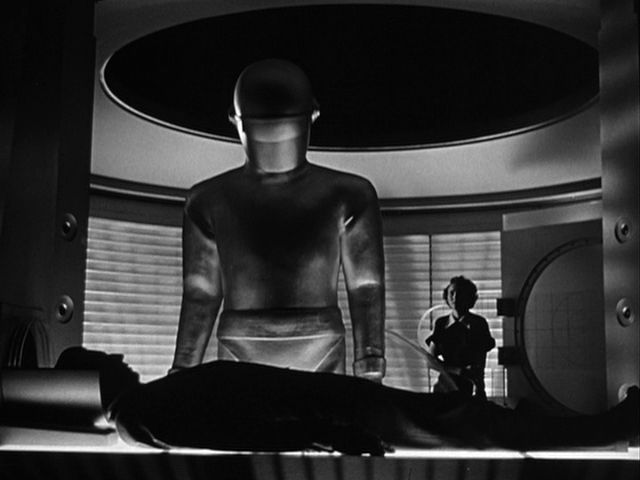
Directed by the legendary Robert Wise, “The Day the Earth Stood Still” is one of the best science fiction films of all time.  Adapted from the sublime short story “Farewell to the Master” by Harry Bates, this iconic movie was released in 1951, when the threat of global nuclear obliteration was at its frenzied apex.  Since then, the story has not lost one iota of its urgency and relevance.  In fact, the more than half century that has passed since the film's premiere has made its final warning even more poignant.


Humanoid alien Klaatu, subtly underplayed by Englishman Michael Rennie, lands his flying saucer in Washington DC, unintentionally instigating a worldwide wave of panic.  Though his purpose is peaceful, Klaatu is accidentally shot by a jittery soldier.  When his requests to address prominent international leaders about his mission are met with snorts of derision, Klaatu decides to magically vanish from his military hospital bed and see for himself if the everyday citizens of Earth are more open-minded and less fearful.


With the authorities searching desperately to find their escaped prisoner from another world, Klaatu befriends a young boy named Bobby, whose youthful enthusiasm is still boundless despite his father’s passing in World War II.  Klaatu knows something about the futility of armed conflict, and he enlists Bobby to help him find someone who will hear what Klaatu has to say: someone who will listen without prejudice. 


So begins the lead-in to one of my most cherished moments in all of cinema.  At Bobby’s suggestion, he and Klaatu pay a visit to Professor Barnhardt, delightfully portrayed by Sam Jaffe.  Finding the professor absent from his office, Klaatu leaves a calling card by solving a complex mathematical equation on the professor’s chalkboard.  This earns him a private meeting, and when Klaatu arrives, he reveals his identity to the professor’s astonishment and joy.


Klaatu puts his life in Professor Barnhardt’s hands, and there is no question about the answer.  The professor quickly walks to his office door and tells the MP that he can go because he knows this man.  Klaatu is pleased and says: “You have faith, Professor Barnhardt.”  Barnhardt replies: “It isn’t faith that makes good science, Mr. Klaatu, it’s curiosity.”  Is that not the argument of the age?  Doesn’t it so succinctly encapsulate the struggles of all human history?


At last we come to the one line of dialogue that utterly undoes me every time.  Professor Barnhardt bids Klaatu to sit down and fixes him with a piercing gaze of intense longing and says: “There are several thousand questions I should like to ask you.”  I am in tears at this heartfelt plea because only the professor understands the colossal potential of what this meeting represents.  Barnhardt is the one person on the entire planet who sees Klaatu for what he is: the greatest single source of knowledge that humankind has ever encountered.


Everyone else on Earth has been mentally hobbled by the hysteria spread through radio and television.  They have stopped thinking critically and calmly.  Instead, the murmuring mob reacts like children crowded round a campfire, shivering with fright at the scary stories being spun with reckless abandon.  Ignorance looms like the advancing twilight.  Only Professor Barnhardt, with his intellect and healthy ego is immune to the subconscious mewling of the lizard brain.  His aching desire to learn is a light in the darkness and serves as a shining example to us all.


Klaatu's final speech to the scientists and other luminaries gathered by Professor Barnhardt is a jaw dropper.  Standing proud and stern on the hull of his ship with the imposing Gort at his back, Klaatu issues an ultimatum of total annihilation should we extend our fledgling atomic activities beyond our little globe.  No threat to the security of the other worlds will be tolerated.  Yet, there is still hope, for Klaatu promises that the Earth will be spared if we can finally put away childish things.  The choice is ours, and if we choose wisely, the entire galaxy will be waiting for us.


“The Day the Earth Stood Still” is not only one of the best films of its genre; it is one of the greatest of all time.  It confronts us with our greatest failings and also celebrates our fondest aspirations.  It shows us who we are and what we would like to be.  It is a dream from the past about a future we could all share if we could only open our hearts and minds wide enough to see the stars and the dazzling destiny that awaits us. When we can finally create the sense of unity that enables us to love our differences and leave our fears behind, then we can truly begin to live.


Wednesday, January 27, 2016

"Making A Murderer" review


A tragic collusion of presumptions

Documentaries are a snake pit of competing perspectives.  Regardless of any director’s claims to objectivity, the very nature of filming is subjective.  No matter how vociferously one may swear to have no agenda, the moment a camera is picked up and shooting begins, choices are made.  Since both the filmmakers and the audience take part in constructing their own personal narrative, the final frame rarely creates a complete consensus on the truth.  Netflix’s original documentary series “Making A Murderer” is compelling and also galling precisely because even after ten hour-long episodes, certitude is scanty.


I binge-watched the entire series one Saturday afternoon and finished at three the following morning.  I had never done this before, and it clearly demonstrates the alluring complexity of the extraordinary circumstances in the life of Stephen Allen Avery.  The story is mesmerizing, the twists are shocking and “Making A Murderer” had instant appeal to a wide audience because of the lingering questions about what Stephen Avery did or did not do.  The case is catnip for conspiracy theorists, who delight in having so much fodder from which to peddle their own theories.


From the very start and throughout the series, every single viewer becomes an armchair detective. When it’s over, they recast themselves as prosecutors or defense attorneys as they argue their particular viewpoints with their family, friends and co-workers.  Everyone has a hypothesis and is sure that theirs is correct.  This is an easy position to adopt since the incomplete evidence, the inconsistencies in testimony and the outright malicious actions on the part of local law enforcement create holes through which many alternate tales can be woven.  The case is a tantalizing puzzle and possibly the greatest gift to water cooler conversation since the JFK assassination.


However, I believe Stephen Avery is innocent for several reasons.  First of all, if Teresa Halbach had been murdered and disposed of as the prosecution claims, then those rooms on Stephen Avery’s property would literally be dripping with her DNA.  Yet the investigators found nothing.  Blood cannot be completely removed from most objects without leaving a chemical trail of some kind, and I don’t believe that Stephen Avery possesses the brains or ability to so utterly expunge all the forensic evidence from a crime scene that should have resembled an abattoir.


Secondly, the key fob from Teresa’s car is found by someone who should not have been allowed to participate in the investigation much less visit the actual crime scene due to a direct conflict of interest.  This person “discovered” the key lying in plain sight after six previous searches by other individuals failed to spot it.  Here’s the kicker: only Stephen Avery’s DNA is detected on the fob.  This is f*cking IMPOSSIBLE.  Teresa Halbach had that key fob in her possession for years, and it should have been soaked in her DNA in the same way as a wet sponge.  Such an obviously manipulated piece of evidence should never have been judged admissible.


Finally, though he is never interviewed on camera, Stephen Avery’s voice and face is present throughout the series via recordings of phone interviews and trial proceedings.  While he is clearly of average intelligence, I could not detect anything in Avery’s choice of words or manner of speaking that contained the slightest whiff of malevolence.  What little is known about Avery’s childhood is certainly not enough in my opinion to justify the despicable things of which he is repeatedly accused.  Furthermore, even after the majority of Avery’s adult life is destroyed by these unfounded accusations, he never displays any rage nor swears any oaths of vengeance.


Now, left alone to rot in prison for the second time, deemed an indefensible pariah even by pro bono legal organizations, Stephen Avery has taken up his case upon himself.  His assertion of innocence has never wavered, and the news and notoriety generated by the series has raised hope from the ashes again.  But even if Avery is granted a new trail, the process will already have been irrevocably stained by the previous assumptions of guilt.  The muckraking media knows a lurid story when they see one, and refuses to address the contradictions of the case.  The court of public opinion has largely condemned Stephen Avery, having also ignored problematic evidence.  I would wager that were he still alive, Lee Harvey Oswald would sympathize.


Thursday, January 21, 2016

"Nightcrawler" review


A dark chocolate with a hollow center

Martin Scorcese’s “Taxi Driver” is a heartrendingly tragic spiral into the black hole of loneliness, and Robert DeNiro’s career-making performance as war vet turned cabbie Travis Bickle epitomizes the emptiness of someone becoming emotionally disconnected from the rest of the world.  Travis is drowning under rising waves of impotence and rage, and this psychological abyss threatens to consume him.  “Nightcrawler” tries to capture this same, sinking sensation of impending doom, but the film's story, much like its main character, remains callow and superficial.


Jake Gyllenhaal’s stark-eyed turn as freelance news videographer Lou Bloom is effectively unsettling, but it lacks the emotional fragility that made Travis Bickle so sympathetic.  Nothing is revealed about Lou Bloom's background to make his actions credible and therefore somewhat understandable.  By the time the credits roll, any glimmers of humanity have been extinguished and Lou Bloom has become a monster. The problem is that we still don’t know why.  This absence of personal motivation is particularly glaring when Lou seeks a romance with Nina Romana, a producer for a bottom tier news channel.


Rene Russo’s performance is compellingly creepy, but unfortunately her character also remains hastily sketched.  Both Lou and Nina are horrible husks of human beings, so Lou’s attraction to Nina makes some twisted sense in that he would find her "quirks" familiar.  However, Lou's pursuit of Nina still feels more like a plot contrivance than a need driven by character desire.  Near the end, when Lou betrays his young assistant and receives no rebuke from Nina, their relationship transforms this sordid story into something truly loathsome: a serial killer soap opera.


“Nightcrawler” feels like a documentary about pornography in which the filmmaker was unable or unwilling to take a stand on whether porn is good or bad or something in between.  The film is sumptuously shot.  The wee small hours of LA's city streets are a lurid labyrinth of glitz and grime, yet very little of substance comes to light as Lou willingly submerges himself deeper into amoral darkness.  Without an origin for his impulses, Lou’s actions become increasingly incomprehensible, and watching this slow, deliberate descent soon fails to be exciting or even interesting.  Instead it just makes you want to take a shower.


Sunday, January 17, 2016

"The Legend of Hell House" - review


A titillating thriller with class

Author Richard Matheson penned many stories over in his long career that were turned into films, and one of the best adaptations is the 1973 version of Matheson’s novel “Hell House.”  With a screenplay by Matheson and direction by Hammer Film’s John Hough, “The Legend of Hell House” rubs ghostly shoulders with Robert Wise’s “The Haunting” and Lewis Allen’s “The Uninvited” as one of the best of all haunted house movies.  While the two earlier films are more subtle in their supernatural shenanigans, all three share an excellent emphasis on the building of dramatic tension.


While “The Legend of Hell House” is a more recent horror film and thus able to be increasingly explicit, thankfully both Matheson and Hough appreciate the value of restraint.  The movie is not cheapened by pointless bloody set pieces, and Matheson also understood that certain sexual aspects of his novel would not pass muster with the movie censors.  There are many lurid elements, but the story never becomes vulgar.  Like its predecessors, this film is suggestive but still remains sophisticated.


As the brooding physicist Dr. Barret, Clive Revill is unswerving in his belief that the spiritual forces in the Belasco mansion can be expunged scientifically with his newly minted machine.  His wife Ann, played by the mature yet sensual Gayle Hunnicutt, is more open to the dark influence of the moldy mansion, yet she never becomes a one-dimensional victim.  Roddy McDowell steadfastly forecasts doom as the weary parapsychologist Benjamin Fischer, the sole survivor of a previous attempt to investigate the Belasco mansion.  Pamela Franklin as young medium Florence Tanner brings a youthful optimism and pride that her skills alone will reveal ancient secrets and bring healing to the phantom palace.


The production design is superb, and the camera placement consistently frames each scene to capture all the gothic details and the devils that may lie within.  The eyes are drawn to every dark corner, hideous sculpture, and loathsome painting, waiting for something to leap from the shadows.  Despite repeated attempts to "clean" the sepulchral space, the malignant mayhem in the mansion only increases in ferocity.  The finale is terrific because it not only makes sense, but it also aligns with everything that has been alluded to previously.  Though the horror is over, uncertainty hangs in the air, insinuating that spectral memories may linger long after the last rites.


"Electric Boogaloo" review


So bad it’s good, or is it?

Ah, the eighties!  The narcissism, the snowdrifts of cocaine and the hurricane of hot pink and neon yellow fashion that assaulted the eyes in much the same way that Cannon Films assaulted multiplex audiences with their cheaply produced and sleazily advertised action flicks and teenybopper sexcapades.  Menahem Golan and Yoram Globus had worked hard to realize their childhood dream of coming to Hollywood to make their own films, but depending on who you talk to, it’s still up for heated debate whether they made any good ones!


The truest answer is a mixture of both.  There are a few actually decent movies in the library of Cannon Films, and they even managed to earn an Oscar for Best Foreign Language Film with their Dutch production of "The Assault" in 1986.  However, the vast majority of Golan-Globus productions were honestly exuberant yet hideously day-glo disasters.  Nonsensical, nearly plotless monstrosities that wore their clumsy pastiche like a patchwork cloak robbed from the grave of a former king.  These movies didn’t care how bad they were, they practically reveled in their tawdry glory!


Menahem Golan and Yoram Globus began their careers in their native Israel with tiny budgets and almost no preparation, yet both men learned quickly how to make the most of very little.  However, the success they earned did not teach them to make better films as they moved forward.  Instead, this dynamic duo focused on quantity over quality, and this emphasis eventually brought about their downfall.


Even the most undiscerning viewer will eventually tire of the same formula, and the output and style of Cannon Films was never able to exorcise the distinct aura of exploitation and sensationalism so redolent in their early films.  This lurid and prurient pall hovered over all their succeeding works, leaving an lingering unease inside, as if the viewer had just consumed a cheeseburger that while not spoiled, did not sit well in the stomach.


Still, sometimes garbage can be fun, and Cannon Films has the distinction of making some of the best “So Bad It’s Good” movies of all time.  Such hilarious atrocities as “The Apple” are astonishing examples of how bad a movie can be right from the start and get worse through its entire running time.  Though made with the best of intentions, this putrescent rock and roll fable is a musical train wreck that steadfastly refuses to stop exploding with sound and fury while signifying nothing.


Regardless of your taste in films, I recommend that a few Golan-Globus productions be experienced if only to bolster the appreciation of the fact that while commitment and perseverance are key factors in filmmaking; if you are unable or unwilling to learn from your mistakes, you will be doomed to repeat them.  At least in the case of Cannon Films, everyone’s funny bone can unintentionally benefit!