Tuesday, November 5, 2013

"Fright Night" (1985) review


 Frighteningly Good Fun

"Fright Night” is one of the great horror films of the eighties.  Furthermore it distinguishes itself as a superb tribute to the genre.  In the same way that “Galaxy Quest” serves up a loving yet ferocious critique of science fiction; “Fright Night” also celebrates every cliché and skewers every stereotype.  The movie oozes homages, and these are incorporated deftly into the suburban setting.  As it does, new life is breathed into what could have easily become a tired affair.  “Fright Night” has all the right chills, but also enough thrills to make it a rollicking good time for all. 


William Ragsdale brings a sweet earnestness to Charley Brewster, a high school student who believes that a vampire has moved into his neighborhood.  As Charley is “just a kid” and known to be a rabid consumer of horror movies, neither his mother nor the police take him seriously when he sounds the alarm about the undead lurking right next door.  His best friend responds to Charley’s growing anxiety with hilarity, while his girlfriend starts to wonder about Charley's sanity.


As for the monster, “Fright Night” embraces completely the concept of a handsome monster that was a new notion in the eighties.  Chris Sarandon injects a sexy sophistication into his performance as master vampire Jerry Dandridge, and Chris conjures an alluring persona of power and charm.  Jerry Dandridge's charisma is compelling, and makes being a creature of the night very attractive despite the damnation downside.  Jerry is able to seduce Charley’s girlfriend merely with his eyes, and now Charley must fight to save her as well as himself.


With nowhere to turn, Charley’s desperation leads him to beg for help from his favorite late night horror movie host, Peter Vincent. Roddy McDowell is a comical delight as the failed actor who is given one last stab at success.  While Peter initially perceives Charley to be a disturbed fan perpetrating a bad joke, a terrifying confirmation soon convinces Peter that Charley is telling the truth.  With the vampire now stalking both of them, this change of faith had mortal implications as certain protective totems will not shield the wielder unless they truly believe.


The final battle in the vampire’s lair is a treasure trove of horror tropes.  Creaking stairs, creeping fog and fluttering drapes all conspire to create an atmosphere of intoxicating fear.  The old school special effects are still excellent, and everything from animation to latex is applied as the vampire tries all his tricks to attack and evade his pursuers.  Ultimately, you think our heroes have carried the day, but even at the end the movie leaves uncertainty drifting in the night air.  “Fright Night” is a terrific film for genre lovers, and the perfectly balanced scares and laughs also result in an excellent choice for non-horror fans.  The story of the undead is as old as the ghost tales shared around flickering campfires, yet in the hands of writer/director Tom Holland the film transcends kitsch and becomes a modern classic.

Wednesday, October 9, 2013

"Gravity" review


Plenty of dazzle, not enough substance

Alfonso Cuaron’s Hollywood career began very well.  He directed “Harry Potter and the Prison of Azkaban”, the first film in that franchise to leave behind Chris Columbus’ sweet but bland ambiance and embrace some much-needed adult darkness.  Cuaron followed that with the superlative “Children of Men”, one of the best post-apocalyptic sci-fi stories of the decade.  As such, I had high hopes for “Gravity”, but unfortunately the film falls flat.


Sandra Bullock and George Clooney are astronauts on a routine space mission that suddenly becomes a soundless, airless nightmare.  Their shuttle is lost, their crew is killed and they are left floating adrift.  The story takes advantage of the fact that the Earth's atmosphere is cluttered with man-made objects, and that each one can provide a potential lifeline or a quick death.  However each attempt that the stranded pair makes to save themselves goes awry, and their options for survival shrink quickly.


Being trapped in open space is a lethal scenario.  You have limited oxygen, there is nothing to hold on to and no rescue team is coming.  You must save yourself.  Sandra Bullock tries very hard to appear terrified, but despite her earnest efforts to be seen as a serious actor, I keep waiting for a punch line.  She’s like the female version of Tom Hanks.  George Clooney’s grizzled veteran also is unconvincing because his constant jokes and unflappable cool are unbelievable given the severity of the circumstances.


“Gravity” also suffers from an over reliance on visual effects to create a sense of danger.  The nearly mute scenes of space debris tearing ships and stations apart are terrifying given the realistic sound mix, but the appeal is mostly technical.  Several moments also glared in their sole inclusion to appeal to the resurgent 3D trend, and I found them as distracting and irritating as a cell phone ringtone.  “Gravity” tries to amaze with a story of a woman finding the courage to live, but the film sinks under the weight of its aspirations, failing to achieve the balance between emotion and calculation.  In space, no one can you meh.

Monday, October 7, 2013

"The Spectacular Now" review


The party’s over, but that's a good thing.

Teen coming-of-age dramadies are a summer movie staple, and given this frequency, the chances of discovering one that has something fresh and original to say grows smaller with each passing year.  There are only so many characters and stories to tell, which is why “The Spectacular Now” is such a pleasant surprise.  While familiar elements abound, the film successfully avoids clichés in favor of small, intimate moments of great significance.


Miles Teller plays Sutter Keely, a charming but salacious, hard-drinking high school senior who loves his non-stop party lifestyle.  However, his girlfriend has just dumped him because she knows that the real world is waiting for both of them after graduation and she wants to make plans.  Sutter doesn’t care about the future, and seeks further distraction by pursuing shy but sweet Aimee Finicky, played by Shailene Woodley. 


As their relationship blossoms, the potential for disaster looms as Aimee, star struck over Sutter's attentions, is drawn into his boozing.  However, Aimee has a positive influence which results in Sutter’s first meeting with his long-absent father.  The experience proves crushing, as Sutter sees a possible future version of himself.  The vision is terrifying and drives him further into the bottle.  A near-fatal accident provides the final catalyst for Sutter’s awakening.

 
The character scenes are so underplayed that it almost works against the film.  There are no big “Oscar” moments, and while this creates a more realistic atmosphere, it threatens to give the movie a flat tone.  I didn’t experience a strong emotional reaction until the very end, but I believe that’s the point.  Change is hard and usually takes a long time to happen, which is why it takes Sutter so long to finally understand that the party’s over.  While that realization is bittersweet, it means that there is hope for his future, and that Aimee can be part of it.

Tuesday, September 24, 2013

"Blue Jasmine" review


Brown Turd

Regardless of what you think of Woody Allen’s personal life, his talent as a writer, director and actor is prodigious and the sustained quality of his work is truly admirable.  Few filmmakers have managed to produce a consistent artistic output for over four decades.  While I had not personally enjoyed a Woody Allen movie since “Sweet and Lowdown”, I hoped that Allen’s propensity for witty dialogue and quirky characters would make “Blue Jasmine” enjoyable, but the film simply stinks.


Cate Blanchett plays Jasmine, a woman who married into great wealth and is now penniless due to her husband’s arrest and conviction over countless illegal business deals.  On a plane in the opening scene, Jasmine is having a markedly one-sided "conversation" with an older woman sitting next to her.  Something is off.  When we next see Jasmine waiting to pick up her luggage, she continues her verbal ramblings.  Jasmine's senior seatmate is there, but soon beats a hasty retreat because she can smell the crazy.  Jasmine is not well, and as the story unfolds we are forced to watch her mental condition deteriorate further.


Cate Blanchett’s interpretation of a spoiled woman suddenly kicked to the curb is superlative.  Her physical beauty is sharply contrasted by the interior ugliness of someone whose narcissism made it easy for her to wrap herself in blinding layers of ignorance.  Jasmine’s breakdown is beautifully portrayed, but it is like watching a corpse decompose.  While fascinating, it is also repulsive, and the reek of Jasmine's willful self-deception is overpowering.  Yet I didn’t feel sorry for Jasmine, but I did feel sorry for Cate.  Such an excellent performance is wasted in a film without any empathy for its players.  Woody Allen usually displays warmth and affinity with at least some of his characters, but in this film his sneering condescension leaves a lingering odor.


“Wild Man Blues” and the more recent eponymous documentary about Allen painted the portrait of a man whose achievements have allowed him a rarified lifestyle, much like the one that Jasmine has lost, making it easy to interpret “Blue Jasmine” as one of Allen’s current nightmares.  Yet, given his autobiographical tendencies in previous films, whether he was mocking the elite or the working class, the humor worked because it felt like Allen knew these characters and liked them despite their flaws.  I wonder if his success has isolated him to the point where he can no longer identify with either social strata and now regards both with equal contempt.  If that’s the case, then it’s no surprise that instead of resulting in a perceptive critique of human foibles, Allen’s “Blue Jasmine” comes out like a cinematic enema.

Tuesday, August 13, 2013

"The Way, Way Back" review


Getting your feet wet

Growth is almost always a painful process, so why are coming-of-age films so  attractive?  Even the good ones often leave a residue of sadness.  There are many good moments from my youth, but the bad ones loom larger because that's when the growing happened.  Adversity requires tough decisions, and the lessons learned stay with us forever.  "The Way, Way Back" is a bittersweet tale of one boy's summer vacation where he takes his first difficult steps into the adult world.  While the story is not original, the sharp dialogue, eccentric characters and breezy pace make for a fun yet familiar frolic.


Duncan doesn't like his new stepfather Trent, and the feeling is mutual.  For his mother's sake, Duncan grimly accepts the situation, though he feels doomed to spend a miserable summer with his family in Trent's house by the shore.  Once they arrive, though the beach and the days are beautiful, Duncan steadfastly broods over his fate.  Susanna, a neighbors' daughter, senses Duncan's alienation and chats him up.  They discover that they share similar family backgrounds as both are children living with divorced single parents.  Despite this flirtation, Duncan is still not ready to come out of his shell, and remains hunched over in a state of awkward withdrawal.


Duncan's emergence is instigated by his friendship with Owen, the slacker manager of a local water park who offers Duncan a job.  While Owen's arrested adolescence initially feels familiar and safe, Duncan slowly realizes that Owen is not a good role model.  Because Owen never takes anything seriously, he avoids making those tough decisions that change a person for the better.  Duncan's job at the water park gives him a sense of responsibility, and that knowledge compels him to act, especially when he discovers Trent's dirty secret.


Being an adult is complicated and it's hard to stand up for yourself, but Duncan finally finds the courage to blurt out the truth about his stepfather because no one else will.  Duncan cannot fathom why his mother would stay with a man like Trent because Duncan is still too young to understand the kinds of compromises adults make.  Even his mother isn't sure that she's doing the right thing.  The future remains uncertain for Duncan's family, but in the end his mother shows him that she is still sure about her love for her son.

Friday, July 19, 2013

"In The Loop" review


A wearying war of words

When this film debuted, the quality of the script was universally lauded as being flush with vicious yet hilarious dialogue.  Well written scripts are rare, and no amount of money or acting talent can compensate for a badly composed screenplay.  “In The Loop” is a British production, and purported to be a welcome deviation from the typically shallow crap Hollywood often excretes.  However, the unrelenting emotional and psychological warfare proves to be an enervating experience.


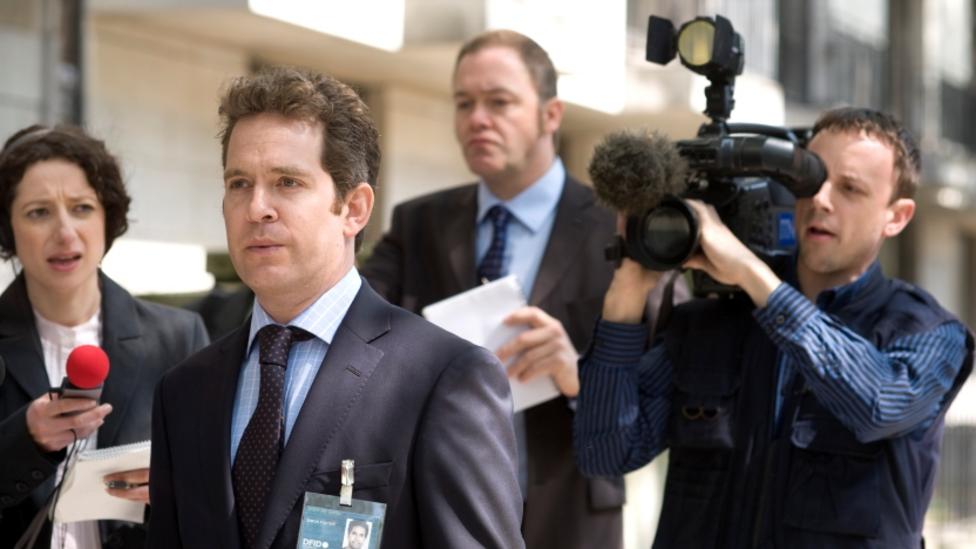
War is brewing in the Middle East, and the American and British governments are at their own sword points about how to proceed.  The focal point of their anger quickly becomes Simon Foster, the British Minister for International Affairs.  Simon is played by Tom Hollander, in a complete reversal of the role for which most Americans will recognize him: the sneering British officer Lord Cutler Beckett from the "Pirates of the Caribbean" franchise.  As Simon Foster, Hollander is a well-meaning but befuddled boob whose unapproved media remarks repeatedly land him in trouble.  Though Simon's boss cruelly criticizes him while scrambling with the damage control, Simon continues to commit the unforgivable political crime of being honest.


Aside from Simon, there are a few other characters that wish to do good, but they understand the limits of their ability to achieve real change.  Simon is the only one who doesn't get it.  While everyone around him is solely focused on advancing their own position of power, Simon remains altruistic. However, the constant threat of scandal, dismissal and death by media suicide looms over every character, and this dread atmosphere quickly becomes tiresome.  I didn't like anyone, not even Simon.  In an environment replete with such duplicity, I wanted to see one good person struggling against the miasma of narcissism, but Simon was just too dumb to support.


Perhaps the point of the film is that one person cannot make a difference, but that is a depressing perspective given how self-serving modern politics appear.  While the vast majority of people in office are likely motivated solely by their own desires, it is an ugly truth in which I would prefer not to have my nose rubbed, regardless of how ruthlessly funny the conversations may be.  It is easy to be cynical about the value of human life, yet I believe that individuals can positively influence the world.  “In The Loop” does not have this small measure of hope, and it suffers from this myopic view.

Thursday, July 11, 2013

"Box of Moonlight" review


A big treasure in a tiny package

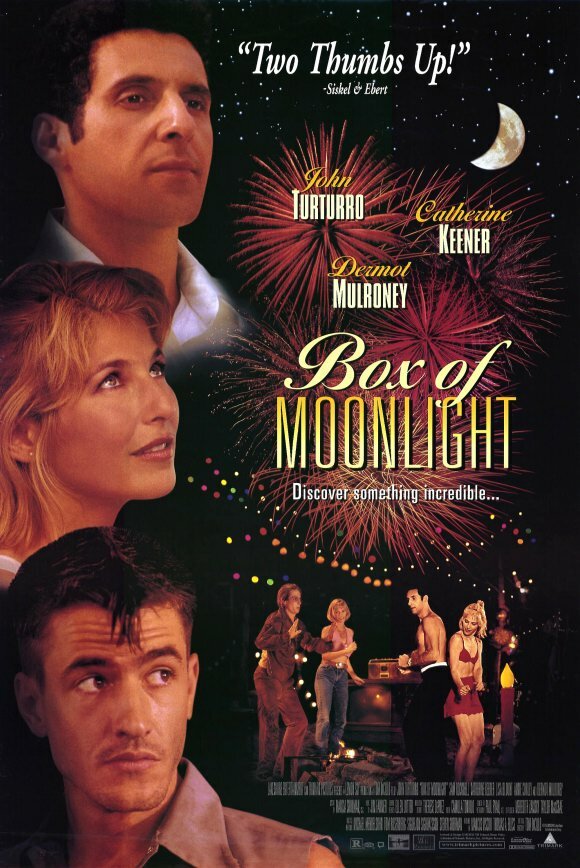
With the rise of the Independent film movement in the 1990’s many talented young filmmakers were able to share their unique vision with a larger audience, thanks in part to the increasing number of film festivals and the participation of name actors.  “Box of Moonlight”, written and directed by Tom DiCillo, is a perfect example.  This quirky dramedy stars John Turturro, who was becoming well known through his memorable roles in early Cohen brothers’ films.  “Box of Moonlight” also boasts early performances by Katherine Keener and Sam Rockwell, both of whom have gone on to develop lasting acting careers.


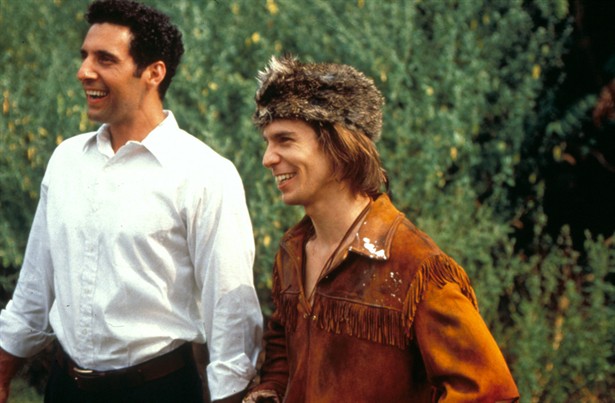
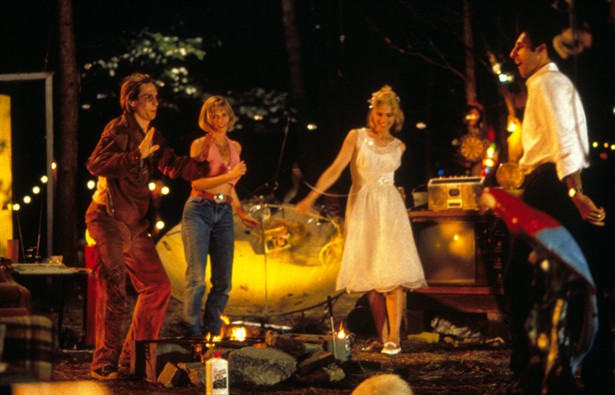
John Turturro plays Al Fountain, an electrical engineer on a field assignment that is suddenly shut down.  When Al calls home to tell to his wife and son, his calm façade belies the fact that Al is on the cusp of a mid-life crisis.  During a meal at a local diner, Al starts to see things moving backwards, and the gray strands he discovers in his hair do little to lessen his growing anxiety.  Instead of heading home, Al suddenly decides to search for a fondly remembered childhood play resort called Splatchee Lake.  When his car breaks down, Al meets a buckskin-garbed local appropriately named Bucky. Played by Sam Rockwell, Bucky is the epitome of perpetual adolescence.  He has abandoned society in order to live off the grid in a patchwork trailer, stealing electricity and making a meager living stealing and reselling lawn ornaments.


Al and Bucky strike up an unlikely friendship, and their adventures together provide the catalyst for Al to begin to finally open up emotionally.  When Al and Bucky go swimming at a partially flooded quarry, they meet two local girls.  Although Al remains faithful to his wife, his passion is reawakened by this harmless flirtation.  Al rediscovers his sense of play and the freedom it brings.  He begins to take pleasure in small things again and recognize their value.  Yet even though Al has long been feeling overburdened with so many mature responsibilities, he never forgets that he has a family.


“Box of Moonlight” is a charming and bittersweet examination of the difficulty in striking a balance between the necessity of meeting adult obligations and realizing that sometimes you just want to be silly, spontaneous, and illogical.  Al realizes that he has been working too hard, and hasn’t stopped to acknowledge and enjoy the fruit of his accomplishments.  Al also recognizes that he hasn’t taken enough time to be with his family, and when he finally returns home, the restrained yet tender scene with he has with his young son provides a spark of hope for a happier future.